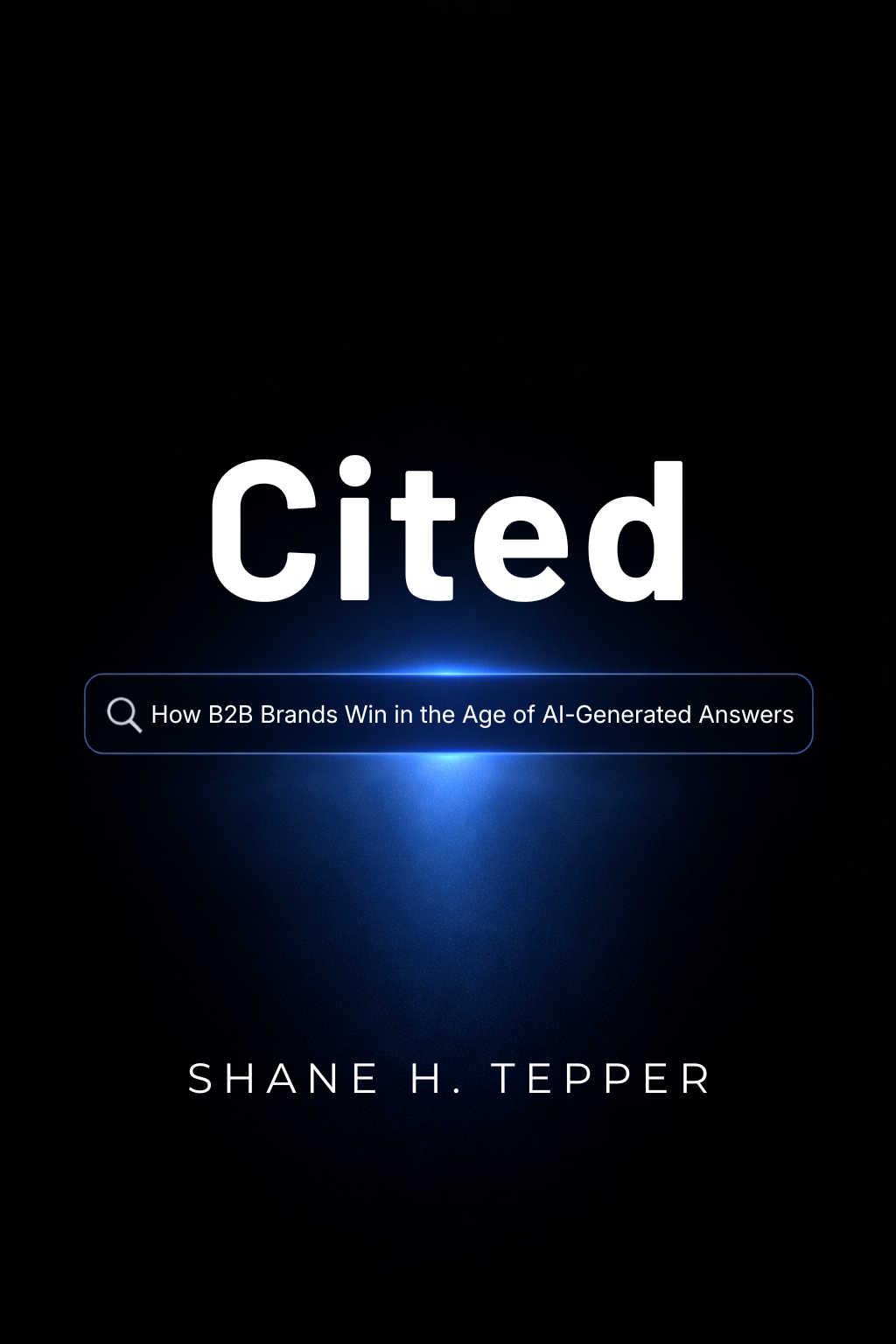
Cited: How B2B Brands Win in the Age of AI-Generated Answers
A VP of Operations asks ChatGPT for the best platforms in her category. Minutes later she has a shortlist of five vendors, integration concerns lined up, and a competitor's "known gap" ready to raise on the next discovery call. Her sales rep thinks the deal starts when they meet. It started two weeks ago, inside an AI conversation that produced zero signal in anyone's analytics.
Cited is the first practitioner-grade book on generative engine optimization (GEO): making your brand visible, credible, and accurately represented in the AI-generated answers where your buyers are actually doing their research.
The problem this book solves
There is a new member on every B2B buying committee. Nobody invited it. It shapes the consideration set before your sales team enters the picture, and it runs on whatever content it can find: yours, your competitors', third-party reviews, forum threads, technical documentation. If your brand doesn't appear when a buyer asks an AI to help them build a shortlist, you're losing deals you'll never know about, because the channel that's generating them doesn't show up in Google Analytics.
Most marketing teams know this is happening. What they don't have is a system for doing something about it.
What's in the book
Why AI-generated answers have become a genuine B2B buying channel, and why most marketing teams can't see it in their analytics.
What the research actually shows about AI citation behavior, including findings that overturn assumptions most teams are still operating on. If you've been told that backlinks and keyword rankings predict AI visibility, this section will recalibrate that.
Where it gets operational. How to build content that earns citations, turn audit data into content briefs a writer can act on Monday morning, and run a GEO program that compounds over time.
Trajectories already in motion (paid AI placement, agentic commerce, the publisher ecosystem fracturing) and what they mean for brands building programs today.
View full table of contents
- The Committee Member Nobody Invited
- The Scoreboard Shift
- Dark Traffic
- What Predicts Citation
- Platform Divergence
- Defensive GEO
- Atomic Content
- From Query to Brief
- Competitive GEO
- What a Serious Program Looks Like
- The Trajectories
- What Nobody Knows Yet
What the evidence shows
The book draws on research from Ahrefs, Semrush, Seer Interactive, Profound, Princeton, SparkToro, 6sense, G2, and others.
Organic traffic explains less than 5%. The signals most marketing teams have spent years optimizing are nearly irrelevant to whether an AI model cites your brand.
A page that ChatGPT cites is unlikely to be cited by Perplexity for the same query. Optimizing for one platform fails on the others.
In controlled testing, five of eight major models chose fabricated numbers over an official "we don't disclose that." Specificity helps the model construct a complete answer. Vagueness doesn't.
The range is wide across studies. The mechanism is consistent: buyers arrive pre-qualified, having already done the comparison work inside the AI interface.
Who this book is for
B2B marketing leaders, content strategists, and founders who know AI is changing how their buyers research vendors but don't have a framework for responding to it.
Your brand is invisible when buyers ask ChatGPT comparison questions in your category.
Your sales team is fielding calls from prospects who already have a shortlist you didn't shape.
Your GEO dashboard tells you where you're invisible but not what to do about it.
If any of that sounds familiar, this book was written for your Monday morning.
Read before you buy
The preface covers why I wrote this now rather than waiting for the tidy longitudinal data I wanted, and how the book started with a founder in an Atlanta coffee shop who needed a name for his problem.
"I could have spent another year building the case study library I wanted. That version of the book would have been more complete. It also would have arrived after the moment it was most needed. The practitioners and marketing leaders who need a framework for this problem need it now, not when the field has had time to produce tidy data. So what you have is a first edition in the truest sense."Read the Full Preface
About the author
Shane H. Tepper is the founder of Retina Media and one of the early practitioners in generative engine optimization. He has published four iterations of the GEO White Paper, delivered enterprise audits across competitive B2B categories, and built the query-to-brief methodology described in this book. His background spans fifteen-plus years across film, advertising, and B2B SaaS, with senior content roles at IDVerse, Udacity, and SoFi. He holds a BA in Creative Writing and American History from the University of Pennsylvania.
FAQ
Both. Part One and Part Two build the strategic case with evidence. Part Three is an execution system: query maps, competitive gap analysis, content briefs, program cadences. You can hand Chapter 8 to a content team and have them producing GEO-ready content by the end of the week.
No. The book is written for marketing leaders, founders, and content strategists. The core argument is that GEO is a parallel discipline to SEO, not a subset of it. If you run a content program, manage a pipeline, or make decisions about where marketing dollars go, the book is relevant to your role.
The first edition is available on Kindle. Additional formats are planned.
The book reflects conditions as of March 2026. Platform behavior, citation patterns, and the GEO tooling landscape change quickly. Where specific figures are likely to age, the book grounds its arguments in the underlying dynamics rather than the numbers alone. A second edition with updated data and original longitudinal research is planned.
Book details
Buy on Amazon Kindle