I. Opening Statement
The charge: The People of the Marketing Profession hereby charge Traditional SEO with the offense of SERP Obsession: the continued optimization for a click-era metric, contrary to the new realities of AI search, against the good order, peace, and professional sanity thereof.
This isn't about whether SEO is "dead." That debate has grown tedious. It's about whether the mental model that made position #1 the holy grail still applies when AI flattens the citation curve and draws from an entirely different source pool.
I've already made the case that the web as we knew it is disappearing: click-through rates collapsing, "dark traffic" from AI conversations invisible to our analytics, an entire middle layer of the internet evaporating into AI training data. That's the context. This piece is about what we optimize for instead, and why it's not the same strategy.
The prosecution will demonstrate, beyond a reasonable doubt, that the old scoreboard no longer reflects the game being played today.
II. Exhibit A: The New Click Physics
The prosecution enters its first exhibit into evidence: the data.
Source: Profound.
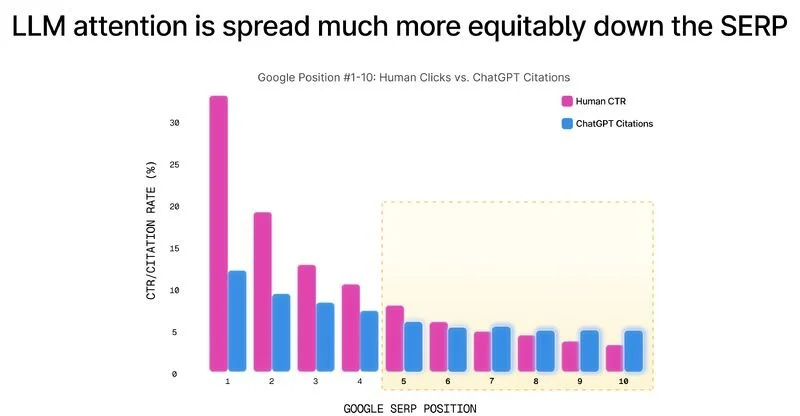
In traditional search, position #1 captures roughly a third of all clicks. Position 5? Around 7%. Positions 7-10? You're fighting over scraps. The dropoff is brutal, which is why SEO became a knife fight for the top spot.
Now look at how ChatGPT cites sources. Position #1 gets around 12% of citations. Position 10? Still pulling 5%. The distribution from positions 5-10 is remarkably flat, each position capturing roughly the same share.
Traditional SEO trained us to think in winners and losers. Rank #1 or be invisible. In AI search, the priority shifts from "win the click" to "be in the consideration set."
III. Exhibit B: Source Divergence
Before we examine whether the old levers work, we need to establish that we're operating in a different ecosystem.
Profound's analysis of 1,000 queries across ChatGPT, Google, and Bing found that ChatGPT results overlap only 19% with the Google SERP. That's a fundamentally different source pool.
Semrush found similar divergence: ChatGPT and Google AI Mode share only 32% of their sources. Each platform has distinct preferences. ChatGPT leans heavily on Wikipedia and Reddit. Google AI Mode, unsurprisingly, cites itself (google.com, blog.google, YouTube). Perplexity favors Reddit, YouTube, and TripAdvisor. Copilot gravitates toward Forbes and Bing.
You can't optimize once and win everywhere. Platform-specific strategy is required.
IV. Exhibit C: The Broken Correlations
Now that we've established it's a different ecosystem, let's examine whether the traditional levers predict outcomes inside it.
Our claim: They don't.
From Profound's analysis across 5 industries and 50,000+ prompts:
"95% of AI citation behavior cannot be explained by traffic (r² = 0.05)."
"97.2% of AI citations cannot be explained by backlinks (r² = 0.038)."
For the non-statisticians: r² measures how well one variable predicts another. These numbers are essentially zero. Traffic and backlinks, the two pillars of traditional SEO, have almost no relationship to AI citation behavior.
In fact, sites with fewer backlinks often receive significantly more AI citations. The old authority signals are more or less meaningless.
Let the record reflect: the two pillars of traditional SEO authority have no statistically significant relationship to AI citation behavior.
V. Exhibit D: The Mention-Source Divide
Semrush's "2025 AI Visibility Index Study" surfaces a distinction that doesn't exist in traditional SEO: the gap between being mentioned and being cited as a source.
Across verticals, only 3-27 brands out of the top 100 mentioned are also top sources. Being talked about does not equal being cited as authoritative. These are two distinct pathways to visibility, and they require different strategies.
The Zapier Paradox illustrates this perfectly:
#1 cited source
#44 in brand mentions
Their content commands authority even when their brand isn't the topic of conversation. That's a GEO win that traditional SEO metrics would completely miss.
VI. The Defense Speaks
Counsel for the defense rises.
Critics argue that GEO is SEO repackaged. The tactics (semantic chunking, structured content, E-E-A-T signals, clear formatting) aren't new. Microsoft's own guidance for AI visibility emphasizes that "traditional SEO fundamentals still matter."
This is true. The tactical overlap is real. Good content structure helps you rank in Google and get cited by ChatGPT. Schema markup, clear hierarchy, machine-readable formatting: these serve both masters.
The defense rests on solid ground when it comes to tactics.
VII. Cross-Examination
But the defense is arguing about tactics when the prosecution is arguing about the optimization target.
Consider: Basketball and soccer both involve running, passing, and teamwork. The skills overlap considerably. But you don't win a soccer match by putting the ball through a hoop.
Same tools, different scoreboard.
SEO optimizes for position #1 because click distribution is brutal. Miss the top spots and you're invisible. GEO optimizes for presence in the consideration set because citation distribution is flat. Positions 5-10 remain viable.
The tactics may overlap, but the success metrics don’t. The source ecosystems don't. And the competitive dynamics don't, either.
Arguing that GEO is "just SEO" because both involve structured content is like arguing soccer is "just basketball" because both involve a ball.
VIII. Verdict
This court has heard the evidence. This court has considered the arguments. This court finds as follows:
GEO is not SEO with a new name. It's a parallel discipline with different:
Success metrics: Citation share and mention frequency vs. ranking position
User journeys: Zero-click synthesis vs. click-through to website
Source ecosystems: 19-32% overlap is divergence, not alignment
Competitive dynamics: Being mentioned ≠ being cited as authoritative
The brands still optimizing purely for position #1 are fighting a war that's already over.
IX. Injunction
The court orders the following remediation:
Map your query universe. Identify the prompts and questions where your brand should appear in AI responses, not just the keywords you rank for.
Audit your citation presence. Track whether you're being mentioned, cited as a source, or both. These require different content strategies.
Structure for extraction. Format content so AI can pull discrete facts, comparisons, and recommendations without requiring synthesis. Think in terms of passages, not articles.
Diversify your source footprint. Each AI platform draws from different wells. Reddit, Wikipedia, YouTube, LinkedIn: your presence in these ecosystems now directly impacts your AI visibility.
Measure what matters. Citation share. Brand mention frequency. Conversion quality from direct traffic. The old dashboard (rankings, impressions, CTR) is increasingly disconnected from actual visibility.
Accept the parallel game. SEO isn't dead. You still need to be in the source pool AI draws from. But ranking doesn't equal visibility anymore. Optimize for both scoreboards.
Compliance is not optional. Court adjourned.
Sources
1. Josh Blyskal, "I analyzed 40,000,000 AI search results," BrightonSEO San Diego, 2025.
2. Semrush, “The 2025 AI Visibility Index Study," August 2025. https://www.semrush.com/news/422790-semrush-launches-ai-visibility-index-the-definitive-industry-benchmark-for-brand-performance-in-ai-search/
3. Fast Company, "Goodbye, SEO. Hello, GEO," 2025. fastcompany.com/91420887/ai-search-seo-geo
4. The Financial Brand, "So Long SEO, Say Hello to GEO," 2025. https://thefinancialbrand.com/news/digital-marketing-banking/so-long-seo-say-hello-to-geo-the-new-digital-discipline-bank-marketers-must-master-192011